

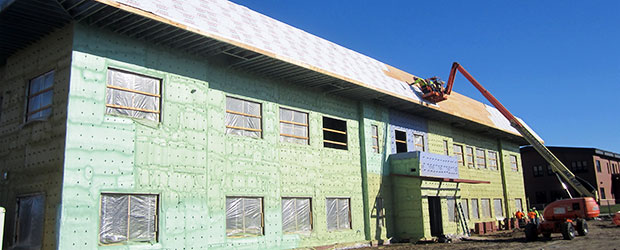
Modern Wall Series: The Air Barrier
Constructing a continuous air barrier system within the building enclosure is likely the most critical component for overall building performance and can help avoid costly failures. In this installment of our Walls Series, we discuss what an air barrier is, ways to ensure adequacy, and why we care so much about it.
Why Incorporate an Air Barrier?
The concept of constructing a continuous air barrier is not immediately obvious – it doesn't add insulation or prevent rain from leaking inside. But, the air barrier system is critical from an asset protection perspective and from an energy conservation perspective.Let's face it - the wind is strong. And wind does weird things on the geometry of building shapes. It creates positive pressure in some places - negative in other places. Vortices, eddy currents, vector profiles: it's all very complex and not terribly relevant to this discussion.
Outdoor air penetrating into a building or conditioned air unintentionally leaving the conditioned space is not a good thing regardless of where the building is on the map. Air barrier failures can create condensation within walls in both hot humid climates and cold dry climates. Breaches in the air barrier also create a bypass through insulation that makes it ineffective and leads to higher energy costs.
So, What's This Bit About Building Exhaust?
Exhaust is designed to do two things: provide an air pressure balance for the building and remove contaminants from occupied spaces. Both of these functions are diminished without a good air barrier system within the walls and roofs – exhaust pulls from all areas including from interstitial spaces and through exterior walls. What should you do about it?Just like any system critical to the success of a product, it's important to test as you go and be clear of the criteria for success. For the air barrier system, this testing should probably be specifically selected and specified at the beginning of the project. We recommend either ASTM E779 or ASTM E1827, both of which are whole building air leakage testing protocols. Ask us what's appropriate for your project.Red Marker Approach. Use a red maker and draw the air barrier layer around the building, showing how it connects from material to material, surface to surface. Any place that has a gap needs revision. Spray foam helps here.
Seal Planned Penetrations. Conduits, pipe penetrations, roof jacks, roof hatches –makes sure that they are filled with an air impervious material like spray foam.
Know the Routing. The air barrier system doesn't always follow the exterior walls and roofs. Sometimes it makes inclusions into the building like around mechanical rooms; sometimes it juts out, like roof penthouses.
Parapets Require Planning. Make sure that your red line extends up and over the parapet walls. Cutting through the wall also works here, just so long as the wall connects to the roof.
Adopt a 1/2 Approach. Ensure a robust air barrier system by considering the interior finishes a contributing factor. Don't rely on finishes, but consider them to be the ½ of the system and install wallboard up to the ceiling deck whenever practical.
Test It! Whole building air leakage testing is here and commonly done on large commercial buildings. Why not test the walls? They'll be in place for decades and it's important to get them right from the start.

